Showing posts with label IMHO. Show all posts

Thursday, 20 March 2014

Dominion - Potion Cards

Alchemy is undoubtedly the most controversial expansion in Dominion, no doubt due to the awkward nature of the Potion cost cards. All of what follows is my humble opinion, on Potion cost cards from a design perspective.

Because each Potion cost card (hereafter PCC) may end up being the only PCC on a given board, it is understood that every potion card should be able to stand on its own as a worthy addition to a deck. However, this means that unless you plan on buying many copies of it, you have introduced an otherwise worthless potion card into your deck for a single PCC. This is bad, so logic follows that any PCC you get, you should want several copies of. What follows in turn, is that the PCC should therefore be a valuable or integral part of your deck.

I think Alchemist demonstrates this perfectly; mediocre by himself, but incredibly powerful with enough of them. Indeed, most good PCCs define the deck they are put in. It is my opinion that self-synergy should be a common feature among PCCs.

As a side note, it is also my opinion that a certain self-synergizing card would be better off requiring a potion:
Like Alchemist, Minions have incredible self-synergy, and define almost any deck they are a part of. They are powerful to the point that they almost cannot be ignored on most boards that they are a part of, and I believe that integrating a Potion into its cost would help make this more of a strategic decision and less of a reflex.

The card that I have made that best demonstrates this behavior is Shaman, who can chain multiple copies from your discard pile to rack up coins.

I intend on adding more Potion cost cards to my fan expansion, and I will be following the design principles outlined here.


Thursday, 24 October 2013

Essential Dominion Articles

Core Strategy Articles:

Building the "First Game" Engine

A wonderful article that introduces players to the depth of strategy available in the wonderful world of Dominion. It takes a beginner level kingdom and adds an advanced level of strategy, backed up by simulation data and interesting writing. A must read for any aspiring Dominion player.

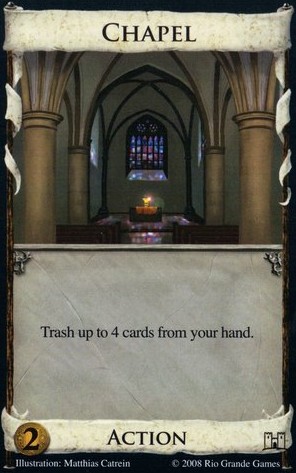
Featured Card: Chapel

A real eye opener for a new player. It really helps you understand the power of trashing and having a slim deck.

Featured Card: Laboratory

Another great featured card that helps to understand the basics of the game.

The Five Fundamental Deck Types

Consists of 5 articles on each of the deck types: Big Money, Slog, Engine, Rush, and Combo. This is a good feature for familiarizing yourself with some of the intermediate strategy to the game.


Important Featured Cards:

Featured Card: Jack of All Trades

Introduces the legendary DoubleJack strategy.

Featured Card: Ill-Gotten Gains

Another Hinterlands card that can change any board that it is on.

Featured Card: Rebuild

Rebuild is another game warpingly powerful card.


Other:

A Dominion Fan Card Creation Guide

This is for anyone aspiring to make fan cards. It outlines common mistakes and pitfalls for card designers, and gives a very good (and thorough) outline of what goes into designing and testing a card.


Thursday, 18 July 2013

Event Horizon and What Makes a Game Scary

Event Horizon is a project of mine wherein I attempt to create a horror game. This will part of a series of articles describing this project.

I started from the Resident Evil series, and tried to figure out what made a game scary from there. I established the shambling hordes of zombies are not particularly frightening. Attempting to come up with an answer for what was scary led me to the following prerequisites for fear:
  • Alertness and investment in the game is critical for an emotional response. During tense periods of the game, you should be forced to give the game your full attention, or else suffer horrible consequences.
    • I want to force a high level of control sensitivity. Halo defaults control sensitivity to 3, I want it to default to 10. The high sensitivity forces players to stay calm in order to aim properly. Tutorials will instruct users to press lightly on thumbsticks (or move mouse only slightly). This is essentially reverse psychology done in such a way that no one would realize it, by demanding calm, you induce panic. It also makes the consequences of losing your nerve more severe, as you swing your aim wildly in panic.
    • I also want to have manual reloading, possibly a Quick Time event, that, while relatively easy, can drop your clip or jam your gun if you rush it. This is again, mainly to keep people on their toes.
  • Intelligent opponents - being forced to outthink enemies is a huge point here. You should have to keep on your toes, with the ability to be killed at any point in time. Equally however, you should have a good fighting chance, as there can't really be fear without hope. 
    • This led me to combat that can end quickly and decisively, similar to that of the Counterstrike series, where a single headshot from the weakest gun can kill an opponent in one hit. In addition, requiring that kind of precision forces the same alertness I mentioned earlier.
    • You will probably be fairly tough, so perhaps Bioshock would be a better comparison. Enemies die quickly, but take chunks out of you. Being run down and low on health and supplies can make even ordinary sections of the game intense, whereas being one-shotted with full health doesn't really add anything to the game, and just makes parts frustrating or unfair to the player. NPCs will probably have their own system as well, such as the ability to be downed and subsequently saved by a timely medical intervention.
  • Limited Resources - I think the most emotionally involving thing about Resident Evil was ammo management. You had to fight carefully and conserve bullets, or else you would be helpless in the next fight, even if you won the current one. Again, this is because it forces you to be careful, to tread the fine line of staying alive now versus staying alive later.
    • I want to use this method, but take it even further. I don't want there to be any benefit to the player engaging in combat, and as such, no enemy in the game will drop any health or ammo. I also want to have non-combat resources to manage; food to keep survivors going. In addition, there will be a global limit to the amount of ammo and healing in the game, shared between you and all of your NPC allies. You will only be able to carry a limited inventory worth of items at any point in time.
  • Consequences - probably the biggest difference between games and real life is the permanence of consequences. This is because in the worst case scenario for games, you just start over, with no real loss. Games like Fallout miss out on this by making quicksave/load too accessible, and allow you to steal every valuable item in the game without any real risk of punishment. In addition, I find that the 'choose who dies' method employed by Mass Effect is not particularly effective at forcing an emotional response, because as I stated before, without hope, you can't get invested in something.
    • I will impose consequences in both the short and long term. If you get hasty, you will take damage, and spend more ammunition than you would otherwise. In addition, NPCs will live or die by your choices and abilities, and the likable ones have the greatest chance of being killed. 
    • I will do what I can to prevent quicksave/load OCD perfection, such as making save points few and far between, and try and force players to soldier on after a bad fight.
  • Limited Information - not knowing everything forces you to pay attention to every scrap of information you can glean. This again, forces you to be alert and invested in the game. This is most commonly done by having poor lighting or otherwise limited visibility, but does not have to be limited to visual effects. It can also be done by limiting the map/radar functionalities of the HUD, but also by level design. Having narrow corridors with lots of openings for enemies to come from, and therefore forcing you to stay aware of each and every one of them.
    • I will have significant flashlight sections, as well as indirect sources of knowledge. By this I mean ways of announcing enemies in the area (such as them talking amongst themselves or distinct animal sounds for non-humanoid enemies, seeing an enemy flashlight ahead of you from around the corner, or even being briefed about probable enemy locations ahead of time)
    • In addition, I want to have it that where the alien atmosphere mixes with the human's controlled atmosphere, it forms a white mist that obscures vision.
  • Pacing - proper1 pacing for any game is alternating sections of calm, and increasing tension. Both are equally important for creating the right atmosphere. This principle applies not only to horror, but any form of entertainment.
An attempt at visualising ideal intensity levels over time.
    • This will be created mainly by the plot, as each mission takes you into greater danger, and then back to the safe zones where survivors are hiding out. Ideally, within each mission there should be similar periods of calm and action. Alternatively, different mission segments can provide the appropriately varying levels of tension; a vehicle section with a mounted weapon with lots of ammunition can be stress-relieving, and then the section on foot after a roadblock can bring the stress right back.
    • Supplies will be done in such a way that it reflects the tension; when you are out on a mission, your supplies will run down, and when you get back to base, you will have access to your hoard of supplies.
    • In addition, I want to not have any randomly spawning or respawning enemies that prevent an area from ever being truly "safe". From my experience with System Shock 2, this is more annoying than scary, and combined with my "no drops" policy, just isn't fair to the player. There may be exceptions to this, as certain areas should never be "safe".
  • Taking players out of their "comfort zone" - this is a little harder to explain, but the best example I can give is underwater segments. In Half-Life, you cannot use most weapons underwater, and have a limited supply of oxygen before you drown. This kind of forced humbling raises player tension; players lose their crutches2, and are forced to reevaluate new ways to deal with the world around them. You can't rely on your powerful weapons underwater, and you can't take things slowly and carefully when you only have a limited supply of air.
    • This is done primarily through the use of limited resources, so that a player cannot become too reliant on any one thing.
    • In addition, the alien atmosphere, outside of that controlled by the human colonists, is toxic, and will use up your suit's power with its filtering, and once that is exhausted, it will slowly kill you. In addition, it fights for that power against your flashlight, sprinting capabilities, and even certain weapons.
    • I also want the AI to factor into this; it should learn your habits and punish you for sticking to the same strategies. They should be constantly trying to outwit you, and their AI should adapt and evolve so that whichever tactics are most effective against you are the ones they will employ more often (this includes both their actual strategies, as well as what units they will use against you)
  • Atmosphere - choosing the right setting is important for a game. There are two main approaches to this in horror. Either you make things as dark and creepy looking as possible, or you do the very opposite, and rely on the uncanny tension that the juxtaposition creates (which is why church organs are now so strongly associated with horror music, clowns are widely considered scary, and creepy children are such a common motif in horror).
    • I aim for the latter, placing this is an extremely upscale space colony, featuring a six-star hotel3 and ample lighting; at first anyways
    • As the game progresses, things get darker and scarier, as horrible things keep happening to the colony. Power is lost, buildings are ransacked, tunnels are flooded, and the dead keep piling up.
All of these were factors in designing the game. I wanted for it to be psychology oriented from the ground up. More information will be in subsequent articles.


1 - This is based on an article I read about pacing. It is from a book, or else I would link to it.
2 - In this context, a crutch is anything a player would normally rely on to deal with a difficulty. It may be a powerful weapon, a certain playstyle, or any other tool at their disposal.
3 - Yes, six stars. The rating system has been altered just to accommodate this level of class. Space tourism isn't cheap, and only the super-rich can afford such accommodations.


Thursday, 9 May 2013

"Please Don't Kill Me" Games

There is a certain subgenre of games that irk me. I will call them "Please don't kill me" (PDKM) games for the purpose of this article.

Essentially, they offer player interaction, but the only meaningful thing you can do with other players is screw them over; selectively. There are no teams, and every player is out for himself. This tends to turn the game into a game of grudges, and dogpiling the person in first place.

This really annoys me as a gamer and as a designer. I can remember many games where my strategy was just to essentially play "multiplayer solitaire" (or turtle, depending on the game) and divert attention from myself. It is very counterintuitive to actively punish players for doing well, and tends to promote "safe" (aka boring) gameplay. I also dislike it because it promotes "metagaming" where you do not play the game, you play the players, and old grudges and biases will haunt you. As someone who typically does well in games, "Please don't kill me" games tend to make me feel like a target.

A few examples of games that fit into this category:

  • Munchkin - By far the worst for this, players hoard nasty cards until a player hits level 9, then players essentially remain there until the group collectively runs out of punishments. I actively dislike this game for that exact reason.
  • Rattus - Not nearly as bad for it, this fits mainly in regards to player roles. If a player can sit on 2-3 roles for most of the game, it is very unlikely he will lose, however if (like me) a player continuously gets his roles stolen, he doesn't really stand a chance of winning.
  • Smallworld - Smallworld fits this pretty much to a tee; however for some reason however, I never seem to mind it as much in this game. Smallworld just seems to have a particular brand of magic that, no matter how much players screw each other over, no one gets mad about it.
  • Risk - This is pretty much why Australia is the best continent. But really though, why would you ever play Risk when there are so many better games available?
There are a lot of different ways to avoid PDKM syndrome.
  • Cosmic Encounter avoids this trap by the cleverly designed Destiny Deck. Whenever you are to make an attack, you draw a card to determine which player you attack. In addition to the standard player cards, there are also special cards that target players meeting certain conditions (e.g. fewest lost ships, most foreign colonies). It also helps that losing your own planets is not overly punishing.
  • Axis and Allies remedies Risk's flaws by forcing predetermined teams.
  • Dominion's attacks hit every opponent, so that you cannot actively pick on a given player.
  • King of Tokyo actually made a solution out of a problem, integrating this into its core gameplay, allowing confident players to become the "King" and take on everyone else
  • Many eurogames don't let players directly attack each other, and only indirectly interfere with each other (by building a road or train route first, or buying key commodities up before they can).
  • Shadows over Japan uses a combination of hidden knowledge and limited actions to keep players from each others' throats. The opportunity cost to attack another player is quite high, requiring you to reveal one of your ninjas, and potentially reveal your allegiance, as well as spending precious actions to move into position and attack. I think it is rather clever, though maybe I'm biased ;)
Until next time,

-Colin


Thursday, 17 January 2013

An Analysis of Pokemon

I, am a fan of Pokemon; however, I feel that Nintendo mishandled the franchise.

The series started with its humble beginnings with the Original Generation of 150 Pokemon; it was fantastic. They did a good job of introducing variety, so that players could build varied and interesting benches based on what they were interested in. Although most veteran players can agree on a choice few Pokemon that formed the "ideal" end-game bench, the cute Pokemon are what drew in a lot of players, and it does help to have a variety of units, even if not all of them are useful. The anime series was well received, and it was an overnight success.

Where I feel that Nintendo misstepped was in how they handled subsequent generations. In the second generation, they added 100 new Pokemon. The only ones that remained from the first generation were ones that had new evolutions in this version.


I feel that they would have been much better off to treat each new generation as an expansion pack for the series, rather than feeling they needed to reinvent the entire ecology of Pokemon for every generation. I would have liked to see maybe 50 new pokemon, and cycle out 50 of the less popular pokemon, resulting in a significant number of new faces, as well as a host of familiar ones, and only 50 new ones to learn, rather than having to start from square one. This also has the benefit of making it not unreasonably hard to 'catch them all', the underlying motto of the series.

In subsequent generations, they misstep again and again. They add 135 new Pokemon in generation 3 (for a total of 385), and again, reinvent the wheel. They added in Leaf Green and Fire Red, remakes of the original generation. I feel that this would have been a great time to consolidate the three generations into something manageable, as the Running Shoes alone made the remakes worth buying, however instead, they stood largely alone, not really affecting the series as a whole in terms of Pokemon biodiversity.

The fourth generation, Diamond and Pearl, adds 107 new pokemon, bringing us up to 492. By this point, it would take a truly dedicated Pokemon master to catch them all, and they are starting to run out of reasonable shapes for their Pokemon, resulting in slightly ridiculous varieties, or species that are derivative of previous Pokemon.

In the fifth generation, Black and White, we add 156 more, for a total of 648. While there is no denying that the game has improved mechanically with each game's iteration, it can equally said that the endearing quality of the Pokemon themselves has diminished with each generation. Beyond the starters and the legendaries, how many Pokemon can you actually name? - and more importantly, how many do you actually care about from the newest generation? 

I feel that Nintendo would have been better off cycling out a smaller portion of each generation, and retaining more Pokemon from generation to generation, allowing favourites to remain a part of the franchise (aside from Pikachu of course, who never seems to go away). By forcing players to learn over a hundred of new Pokemon each time they want to pick up a new game, and virtually guaranteeing that their favourites will not be in the next one, they are isolating a lot of their core fan base. 

Pokemon games are still fun, and it is good to see them experimenting with new formats and inter-generational mingling. Games such as Pokemon Conquest are refreshing, and promising for the future of the franchise, as it has become abundantly clear that their current path is not the correct way to continue. I still enjoy Pokemon, but I haven't been very interested in them lately because there are just too damn many of them.

Until next time,

-Colin Souva