Showing posts with label Review. Show all posts

Thursday, 2 October 2014

Dominion: Enterprise

Dominion: Enterprise is a Dominion expansion, which is not mine. I have had a long standing interesting in making new Dominion cards, and this is the only one of the many I have seen that caught (and held!) my interest.

I'm including the card text at the time of this review, just in case the images get lost or revised.

Clerk - $2 Action
+1 Card
+1 Action
Look through your discard pile. You may reveal a Copper from it and put it into your hand.

Really cool, very powerful for a 2 cost card. Potentially just a cantrip, but generally a Peddler for $2, that you can't stack very well. My gut says it should be a 3 cost card.

4 Stars
Jubilee - $2 Action
+2 Actions
+$2
You may pay a trade token; if you don't, return this to the supply.
---
When you gain this, take a Trade token.

Solid card. My only complaint is that it returns to the supply instead of being trashed, which makes it nigh-impossible to deplete as a pile.

4 Stars
Redistrict - $2 Action
Choose a card in your hand. Trash it, and gain a card costing exactly $1 more than it.
You may trash this, If you do, gain a card costing exactly $2 more than the chosen card.

Another pretty cool $2 card. The wording is slightly unclear, whether "the chosen card" is the one from your hand, or the one you chose to gain. I think it is worded like that so that you can gain a card costing $2 more without gaining one costing $1 more (probably most relevant trashing Gold into Province).

4 Stars
Auction - $3 Treasure
+1 Buy
When you play this, discard your hand. Worth $1 per card discarded.

Essentially a Secret Chamber turned into a treasure. It seems like it would be worse than Silver most of the time. I don't see any reason this couldn't cost $2. Also, the "When you play this" is entirely unnecessary, as is the word "Worth".

3 Stars
Convoy - $3 Action
+2 Cards
Look at the top 3 cards of your deck. Discard one, and put the rest back in any order. You may pay a Trade token to play this again.
---
When you gain this, take a Trade token.

Designed to be a self-synergy card. Decent for $3, though it seems difficult to get excited about. It probably works well with engines, as discarding a card and rearranging the other two is probably about as helpful as drawing an extra card, so it compares favourably with Smithy.

3 Stars
Floodgate - $3 Victory
2 VP
---
When you gain this, set it aside along with up to 4 cards from your hand. At the start of your next turn, put all the set-aside cards into your hand.

Pretty neat. Its use isn't immediately apparent, but it is probably amazing for late game. Instead of buying a Duchy, get a Floodgate instead, keep the $2-4 extra for next turn.

3 Stars
Gambler - $3 Action
+1 Card
+1 Action
Look at the top card of your deck and choose one: Trash that card; or put that card into your hand and trash this.

Gambler seems like the type of card you almost always want to open with. It is like a much better Lookout, and is probably a lot more fun to play with. You can even use it as a one-shot Laboratory, which can make for some interesting strategies.

5 Stars
Mill Town - $3 Action
+1 Card
+2 Actions
You may reveal your hand and gain a card costing up to $1 per Copper you revealed.

The village of the set. Pretty neat ability, it is a workshop-village hybrid. I imagine it is pretty powerful for kickstarting your deck, but falls off. Seems like it should be fun.

5 Stars
Refurbish - $3 Action
Trash a card from your hand. Gain a Silver.
---
While this is in play, Silvers produce an extra $1

Interesting. I can't say I like it that much, as I have no idea what kind of deck wants it. That being said, I've never played with it, so what do I know?

2 Stars
Committee - $4 Action
+$2
Reveal cards from your deck until you reveal 2 differently named cards. If you did, the player to your left chooses one of the revealed cards. Either trash it, or gain a copy of it. Discard the untrashed cards.

Interesting. I'm not entirely sure why the "If you did" is necessary, and some of the other wording is a bit clunky. The effect itself seems interesting enough to pique my curiosity,

3 Stars.
Craftsman - $4 Action
You may pay a Trade token to gain a card costing up to $5. Otherwise, +1 Card, +1 Action, and take  a Trade token.

The only card that can generate trade tokens not on buy/gain. I feel like it is probably a little bit weak by itself (for reasons similar to university), but much more powerful in combination with other Trade token cards.

3 Stars.
Dignitary - 4 Action Reaction
Look at the top 2 cards of your deck. Put any number of them into your hand, +$1 for each card you put back.
---
When another player plays an Attack card, you may reveal this from your hand. If you do, trash all but 4 cards from your hand.

Having followed this set for some time, I'm aware of the struggle of wording the bottom section. The current incarnation isn't bad, but presents some odd interactions with Rats and Cultist. I like the above-the-line ability, although I think there isn't any reason this couldn't cost $3.

3 Stars.
 
Recruiter - $4 Action Reaction
+$1
Gain a Conscripts from the Conscripts pile, putting it on top of your deck.
---
When another player plays an Attack card, you may discard this. If you do, gain a Conscripts from the Conscripts pile, putting it into your hand.

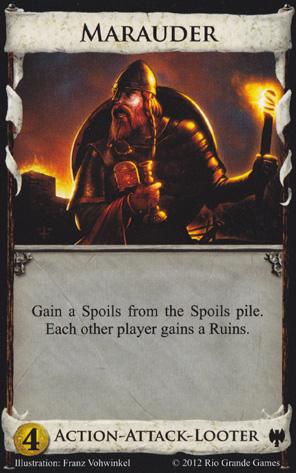
Interesting reaction, fairly bland action. This is difficult to judge, because it is tied in so closely to Conscripts. This feels very similar to Marauder, except that the card you get stays around (some of the time).

2 Stars
Conscripts - $0* Action Attack
+1 Action
+$2
You may reveal an Attack card from your hand. If you do, return this to the Conscripts pile and each other player gains a Curse.
(This is not in the Supply)

I might as well review Conscripts here as well; I like the idea of a one-shot attack, but I can't quite decide what it should do. Cursing seems too powerful, discarding seems too weak. Generating coins seems kind of odd, but I don't know what else I'd want it to do. I also know that this card has been through a lot of iterations, so presumably it is more reasonable than I realize, but that doesn't mean I have to like it.

3 Stars
Terrace - $4 Action
+1 Card
+2 Actions
You may pay a Trade token to discard your hand and draw 5 cards.
---
When you gain this, take a Trade token.

This card seems pretty nuts. A village that lets you do a minion-esque redraw, but with 5 cards instead of 4. It seems crazy, but the more I think about it, it is probably not overpowered, as you can't abuse it in a treasure deck (Black Market excepted), or an engine (due to limited Trade tokens).

5 Stars
Vendor - $4 Action
+2 Cards
+1 Action
+1 Buy
You may discard a treasure. If you don't, trash this.

Pretty cool. Seems overpowered, but because you have to discard treasure, the net effect is pretty reasonable. Also adds skill in knowing when to trash them, and if you want to risk playing it in a hand with no treasure.

4 Stars
Axeman - $5 Action Attack
+$2
Each other player with 5 or more cards in hand trashes a card from his hand costing at least $3 (or reveals a hand with no such cards). He may gain a cheaper card, putting it on top of his deck.

By far my least favourite card of the set. Essentially a hybrid of Pillage and Saboteur, neither of which I am a fan of, it targets high-costing cards in your hand, and replaces them with cheaper cards.

There have been multiple versions of this card, and I've hated them all. It is an ugly concept; I'm not convinced it can be fixed.

1 Star.

 
Barracks - $5 Action
+1 Action
Choose one: Gain 2 Conscripts from the Conscripts pile; or reveal cards from your deck until you reveal an Attack card, put that Attack card into your hand, and discard the rest.

Having already reviewed Conscripts, here is Barracks, the other card that uses them. I like this card a lot more than Recruiter (my issues with Conscripts notwithstanding); its cool self-synergy of gaining and digging for attacks.

4 Stars
Barrister - $5 Action Attack
Each other player reveals the top 2 cards of his deck, trashes a revealed Treasure other than Copper, and discards the rest. Gain a Treasure from the trash, or a Silver, putting it into your hand.
---
Setup: Replace one of each player's starting Coppers with a Domain.

The art on Barrister may look familiar, but is entirely a different card from my Tariff. This card has been through some iterations, and I like its current form. It is a sort of thief-explorer hybrid, and it is unusual and interesting enough to rouse my interest.

4 Stars

Domain - $3 Treasure Victory
$1
---
Worth 1 VP for every Domain in your deck.

While we're at it: Domain. Probably the best replace-a-copper-in-your-starting-deck variant I've seen. The increased cost makes it interesting for trash-for-benefit cards, and it has a neat interaction with Barrister, and its dual-type helps keep things interesting overall.

4 Stars
Barter - $5 Action
+1 Action
Trash a card from your hand. Gain a card costing up to $2 more than it. You may pay a Trade token to put the gained card into your hand.
---
When you buy this, take 2 Trade tokens.

A Remodel variant. Non-terminal, with the option to put the card into your hand. Not sure why it gives you 2 Trade tokens on the buy, though this was a deliberate buff (it used to only give 1). A solid card.

4 Stars
Cathedral - $5 Action
+3 Cards
+1 Buy
You may pay a Trade token to trash 2 cards from your hand.
---
While this is in play, when you buy a Victory card, take a Trade token.

Pretty cool. The Trade tokens seem like a pittance - being able to trash 2 cards in exchange for buying one; however, if you have multiple Cathedrals in play, you gain more than one token per buy. You can probably set up some really cool combos with this. Also, it seems kind of weird you have to trash exactly 2 instead of up to 2.

4 Stars.
Conclave - $5 Action
+1 Action
Reveal the top 3 cards of your deck. From the revealed cards, choose an Action card, a Treasure card, and a Victory card. Put those cards into your hand and discard the rest.

So freaking cool. A sort-of-Cornucopia Laboratory variant. Love it.

5 Stars.
Fund - $5 Treasure
$2
When you play this, you may trash it. If you do, +1 Buy and gain a Silver, putting it into your hand.

One shot money. Neat, solid, but doesn't seem too exciting (though probably a cool combo with Barrister)

3 Stars
General - $5 Action
You may play an Action card from your hand twice; when you would trash or otherwise remove that card from play during your Action phase, don't. When you discard that card from play, you may put it on top of your deck.

I like the concept of play twice now, once later, but I firmly dislike the cannot be removed from play business, and am not 100% sold on the wording. I'd much prefer it as a simpler Throne room with automatic Scheming.

2 Stars with the potential to be 4.
Wheelwright - $5 Action
Discard any number of cards. Draw until you have 7 cards in hand. Each other player may gain a Copper, putting it into his hand.

I really like this card. Discard-and-Draw-Up-To is a concept I had been trying to do, but between this card and Archivist, I don't think I can come up with anything better. 

5 Stars.


Overall: 4 Stars
1 Star - 1
2 Star - 3
3 Star - 8
4 Star - 9
5 Star - 5


Thursday, 15 November 2012

What Starcraft Does Right

In a word: everything.

Starcraft and Starcraft II are probably the best RTSs in history. I will usually refer to them collectively as Starcraft throughout this article, and probably Brood War (BW) or Starcraft II (WoL) when referencing one in particular.

What makes Starcraft so good?

  • Responsiveness
One of the first things I immediately liked about the original Starcraft was how responsive the units were. Tell them to move, and they moved. It is surprising how many games screw that up; Dawn of War is particularly bad for this, where you can only tell your units a vague area to go to, and must rely on their (idiotic) AI to guide individual units.

Starcraft gives you pretty much perfect control over your units, allowing and even requiring you to position them individually for optimal play. 
  • Racial Diversity
Starcraft is probably the most diverse RTS out there. It has three genuinely unique races, each with completely unique play styles and strategies. Each of their economies works differently, each aims for different types of engagements, each peaks in power at different points in the game - and above all else, each is balanced.

Even within each race, there are massive opportunities for diversity of play style. You can play aggressively or aim for economy; you can favour a tech-rush strategy, you can aim for mass units and production, or you can catch your opponent off guard with unusual technology and special tactics.

The sheer mind-boggling possibilities of the game speak volumes of the undeniable amount of time and effort that has gone into testing and balancing the game; the elegance of the design and the robustness of its systems.
  • Economy
The subtle brilliance of Starcraft is hidden in its economy. I won't get into the individual race's traits in building and maintaining their economies, rather the resources as a whole.

There are two primary resources: Minerals and Vespene Gas. 
Minerals are the primary resource, available in abundance with a high capacity for mining and a relatively low maximum yield (at 1500 per field)
Gas geysers vary from BW to WoL; BW gives one geyser per base with 5000 gas, WoL gives 2500 gas in each of 2 geysers. They have a low variance, and can expected to be mined at a constant rate per base. (By this I mean they achieve worker saturation easily, and it is generally expected that you would max out your gas collection more so than your minerals)
There is also the tertiary resource of Supply, which is created by building the required buildings/overlords with your minerals.

Lower tech units require more minerals and supply, while higher tech units require more gas. Lower tech units are also more mobile, while higher tech units are much stronger but slower. Ultimately, the backbone of your forces is made of minerals, while the muscle is made from gas.

This creates the following economic metagame: early game, you expand regularly and build basic units with your minerals. As the minerals in your starting bases begin to die, you must expand to secure more minerals - however your original gas geysers are not expired yet, giving you proportionally more gas, which fits right in with your plans of advancing to higher tech.

You start off quite far from your opponent, which fits that the earlier units should be faster; however, as the game advances, your bases creep slowly towards each other as you expand over the map. The game then shifts towards a battle of positioning, with the slow late-game units besieging the more exposed enemy positions (as you get more bases, it gives you more area to defend, with slower units to defend it).

Seeing it explained like that, can you help but appreciate the brilliance of Starcraft's design? None of that is explicitly stated or coded anywhere, however, because of the incredibly clever way the game was put together, that metagame has shaped the way that people play Starcraft.
  • The Races
I won't actually get into the races themselves, but I want to comment on how perfect 3 is for the number of races in an RTS.

Ignoring mirror matchups, the number of potential matchups scales triangularly (muahaha), so that even a single additional race would double the potential number of matchups. As anyone who has tried to balance anything should know, this makes things exponentially more difficult. 

Having only a single non-mirrored matchup gets boring pretty quickly, as anyone who played the first few Command & Conquer games found out (and probably why they moved to a 3-race format in later games). 

Having 6 match ups makes things overwhelming, as there is twice as much to follow, to prepare for, and to balance. Twice as many interactions usually means half as much balance, which isn't good for anyone.
  • Skill Ceiling
Starcraft is great because it is playable and enjoyable, even for new players; but at the same time, you can (literally) play the game for 16 hours a day for years, and still not have mastered it. There is always some new facet to be explored.

Starcraft is the game that spawned the term APM (actions per minute); which measures your ability to command the battlefield. Good players usually have very high APM; 200 is a common threshold for skilled players to reach, while some players will go to 300 and higher.

Top-tier Starcraft players are in a world unto themselves; they have such mastery of the mechanics and strategies of the game that regular players don't stand a chance against them. Watching Pros is a great experience, and can teach you about how to improve your gameplay.

The skill ceiling is great because it gives you something to work towards without relying on the stick-and-carrot methods employed by RPGs. It also allows player to practise and improve without relying on avatar strength.
  • Unit Diversity
Within each race, each unit feels truly unique. There is no overlap between units in what tactical role they fulfill. This goes a long way to giving each unit a distinctive feel and play-style on the battlefield.

 Starcraft employs a "rock-paper-scissors" approach to its unit design, which ties in very well to scouting. It is vital to the game that you keep tabs on what your opponent is doing, and you prevent him from learning too much about what you are doing in turn. If you see your opponent stockpiling Scissors, you'd best start building some Rocks, or else your Paper will get shredded.

This is better than most games, whose units tend to feel pretty interchangeable (C&C, Age of Empires); which tends to result in a monoculture of the best unit available, with the occasional smattering of support units.

By making various units "super-effective" against others, it forces diversity and interesting unit compositions to the fore-front of battle; also ensuring that the engagements themselves are involved and benefit skilled tacticians more than '1-A'ers, as the rocks seek to avoid the paper and gouge into the scissors of their opponent's army.
  • Community
Part of what makes Starcraft so great is the community that plays it. Starcraft has a far better community than League of Legends (which is notorious for its troll-infested player base)

In addition to the generally nicer players, there are also dedicated community sites, such as Team Liquid, that provide forums for players to discuss Starcraft, or just life in general. It is also a great place to find player streams; professionals or otherwise who broadcast games.


Starcraft is a game great for both watching and playing. I heartily recommend it to anyone who is looking for an outlet for their creativity and dedication. It is not an easy game, but is fun and rewarding; even if is occasionally frustrating that you are not as good as the Koreans out there. But more on that later.

-Colin